
Digital Marketing Tutorial
Digital
Marketing
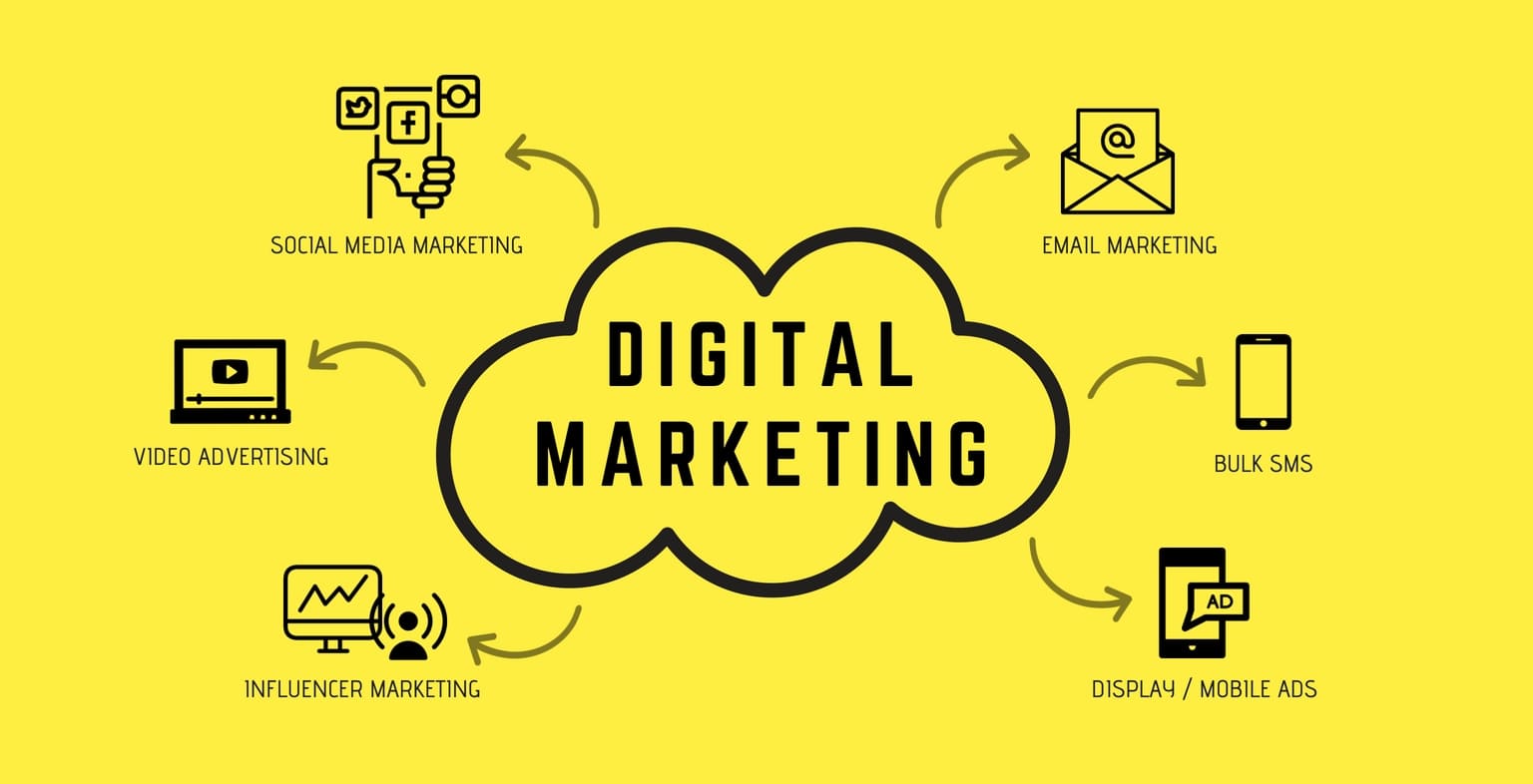
What is Digital Marketing?
Digital marketing is advertising delivered through
digital channels. Channels such as social media, mobile applications, email,
web applications, search engines, websites, or any new digital channel.
What's the Future of Digital Marketing?
The offline and online world are colliding.
Traditional devices such as fridges, ovens and even billboards will all be
modernized to leverage digital media.
Why Digital Marketing Matters?
Google and Facebook generate more revenue than any
traditional media company because they control more eyeballs. That's why
digital marketing matters, it is where the attention is.
What channels make up digital marketing?
Search engines, social media, blogs, online ads,
affiliate marketing, emails, and mobile apps.
How does a business define digital marketing?
Digital marketing is defined
by the use of numerous digital tactics and channels to connect with customers
where they spend much of their time: online. From the website itself to a
business's online branding assets -- digital advertising, email marketing, online brochures, and beyond --
there's a spectrum of tactics that fall under the umbrella of "digital
marketing."
The best digital marketers
have a clear picture of how each digital marketing campaign supports their
overarching goals. And depending on the goals of their marketing strategy,
marketers can support a larger campaign through the free and paid channels at
their disposal.
A content marketer, for example, can create a series of
blog posts that serve to generate leads from a new ebook the business recently
created. The company's social media marketer might
then help promote these blog posts through paid and organic posts on the
business's social media accounts. Perhaps
the email marketer creates an email campaign to send
those who download the ebook more information on the company. We'll talk more
about these specific digital marketers in a minute.
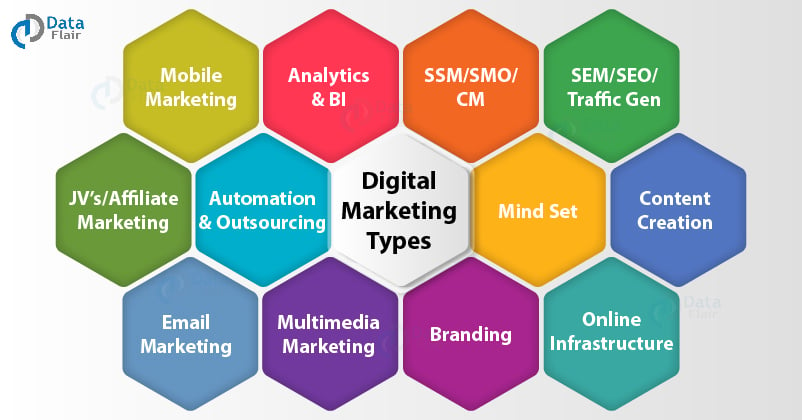
Types of Digital Marketing
1. Search Engine Optimization (SEO)
2. Content Marketing
3. Social Media Marketing
4. Pay Per Click (PPC)
5. Affiliate Marketing
6. Native Advertising
7. Marketing Automation
8. Email Marketing
9. Online PR
10. Inbound Marketing
11. Sponsored Content
Here's a quick rundown of some of the most common digital marketing
tactics and the channels involved in each one.
Search Engine
Optimization (SEO)
This is the process of optimizing your website to "rank"
higher in search engine results pages, thereby increasing the amount of organic
(or free) traffic your website receives. The channels that benefit from SEO
include websites, blogs, and infographics.
There are a number of ways to approach SEO in order to generate
qualified traffic to your website. These include:
·
On page SEO: This type of SEO focuses on all of the content that
exists "on the page" when looking at a website. By researching
keywords for their search volume and intent (or meaning), you can answer
questions for readers and rank higher on the search engine results
pages (SERPs) those questions produce.
·
Off page SEO: This type of SEO focuses on all of the activity
that takes place "off the page" when looking to optimize your
website. "What activity not on my own website could affect my
ranking?" You might ask. The answer is inbound links, also known as
backlinks. The number of publishers that link to you, and the relative
"authority" of those publishers, affect how highly you rank for the
keywords you care about. By networking with other publishers, writing guest
posts on these websites (and linking back to your website),
and generating external attention, you can earn the backlinks you need to
move your website up on all the right SERPs.
·
Technical SEO: This type of SEO focuses on the backend of your
website, and how your pages are coded. Image compression, structured data, and
CSS file optimization are all forms of technical SEO that can increase your website's loading speed -- an important ranking factor in the eyes of
search engines like Google.
Content Marketing
This term denotes the creation and promotion of content assets for the
purpose of generating brand awareness, traffic growth, lead generation, and
customers. The channels that can play a part in your content marketing strategy
include:
·
Blog posts: Writing and publishing articles on
a company blog helps you demonstrate your industry expertise and
generates organic search traffic for your business. This ultimately gives you
more opportunities to convert website visitors into leads for your sales team.
·
Ebooks and whitepapers: Ebooks, whitepapers, and similar long-form content
helps further educate website visitors. It also allows you to exchange
content for a reader's contact information, generating leads for your company
and moving people through the buyer's journey.
·
Infographics: Sometimes, readers want you to show, not tell.
Infographics are a form of visual content that helps website visitors visualize
a concept you want to help them learn.
Want to learn and apply content marketing to your business?
Check out Workforce_Kolkata
Social Media
Marketing
This practice promotes your brand and your content on social media channels to increase brand
awareness, drive traffic, and generate leads for your business. The channels
you can use in social media marketing include:
·
Facebook.
·
Twitter.
·
LinkedIn.
·
Instagram.
·
Snapchat.
·
Pinterest.
If you're new to social platforms, you can use tools like Fiverr.com to
connect channels like LinkedIn and Facebook in one place. This way, you can
easily schedule content for multiple channels at once, and monitor analytics
from the platform as well.
On top of connecting social accounts for posting purposes, you can also
integrate your social media inboxes into Fiverr.com, so
you can get your direct messages in one place.
Pay Per Click (PPC)
PPC is a method of driving traffic to your website by paying a publisher
every time your ad is clicked. One of the most common types of PPC is Google Ads, which allows you to pay for top slots on
Google's search engine results pages at a price "per click" of the
links you place. Other channels where you can use PPC include:
·
Paid ads on Facebook: Here, users can pay to customize a video, image
post, or slideshow, which Facebook will publish to the newsfeeds of
people who match your business's audience.
·
Twitter Ads campaigns: Here, users can pay to place a series of posts or
profile badges to the news feeds of a specific audience, all dedicated to
accomplish a specific goal for your business. This goal can be website traffic,
more Twitter followers, tweet engagement, or even app downloads.
·
Sponsored Messages on LinkedIn: Here, users can pay to send messages directly to
specific LinkedIn users based on their industry and background.
Affiliate
Marketing
This is a type of performance-based advertising where you receive
commission for promoting someone else's products or services on your website.
Affiliate marketing channels include:
·
Hosting video ads through the YouTube Partner Program.
·
Posting affiliate links from your social
media accounts.
Native
Advertising
Native advertising refers to advertisements that are primarily
content-led and featured on a platform alongside other, non-paid content.
BuzzFeed-sponsored posts are a good example, but many people also consider
social media advertising to be "native" -- Facebook advertising and
Instagram advertising, for example.
Marketing Automation
Marketing automation refers
to the software that serves to automate your basic marketing operations. Many
marketing departments can automate repetitive tasks they would otherwise do
manually, such as:
·
Email newsletters: Email automation doesn't just allow you to
automatically send emails to your subscribers. It can also help you shrink
and expand your contact list as needed so your newsletters are only going to
the people who want to see them in their inboxes.
·
Social media post scheduling: If you want to grow your organization's presence on
a social network, you need to post frequently. This makes manual posting a bit
of an unruly process. Social media scheduling tools push your content to your
social media channels for you, so you can spend more time focusing on
content strategy.
·
Lead-nurturing workflows: Generating leads, and converting those leads into
customers, can be a long process. You can automate that process by sending
leads specific emails and content once they fit certain criteria, such as when
they download and open an ebook.
·
Campaign tracking and
reporting: Marketing campaigns can include a ton of
different people, emails, content, webpages, phone calls, and more. Marketing
automation can help you sort everything you work on by the campaign it's
serving, and then track the performance of that campaign based on the progress
all of these components make over time.
Email Marketing
Companies use email marketing as a way of communicating with their
audiences. Email is often used to promote content, discounts and events, as
well as to direct people toward the business's website. The types of emails you
might send in an email marketing campaign include:
·
Blog subscription newsletters.
·
Follow-up emails to website visitors who
downloaded something.
·
Customer welcome emails.
·
Holiday promotions to loyalty program
members.
·
Tips or similar series emails for customer nurturing.
Online PR
Online PR is the practice of securing earned online coverage with
digital publications, blogs, and other content-based websites. It's much like
traditional PR, but in the online space. The channels you can use to maximize
your PR efforts include:
·
Reporter outreach via social
media: Talking to journalists on Twitter, for
example, is a great way to develop a relationship with the press that produces
earned media opportunities for your company.
·
Engaging online reviews of your
company: When someone reviews your company
online, whether that review is good or bad, your instinct might be not to touch
it. On the contrary, engaging company reviews helps you humanize your brand and
deliver powerful messaging that protects your reputation.
·
Engaging comments on your
personal website or blog: Similar
to the way you'd respond to reviews of your company, responding to the people
who are reading your content is the best way to generate productive
conversation around your industry.
Inbound Marketing
Inbound marketing refers to a marketing methodology wherein you attract,
engage, and delight customers at every stage of the buyer's journey. You
can use every digital marketing tactic listed above, throughout an inbound
marketing strategy, to create a customer experience that works with the
customer, not against them. Here are
some classic examples of inbound marketing versus traditional
marketing:
·
Blogging vs. pop-up ads
·
Video marketing vs. commercial advertising
·
Email contact lists vs. email spam
Sponsored Content
With sponsored content, you as a brand pay another company or entity to
create and promote content that discusses your brand or service in some way.
One popular type of sponsored content is influencer marketing. With this
type of sponsored content, a brand sponsors an influencer in its industry to
publish posts or videos related to the company on social media.
Another type of sponsored content could be a blog post or article that
is written to highlight a topic, service, or brand.
What does a digital marketer do?
Digital marketers are in charge of driving brand awareness and lead generation through
all the digital channels -- both free and paid -- that are at a company's
disposal. These channels include social media, the company's own website, search
engine rankings, email, display advertising, and the company's blog.
The digital marketer usually focuses on a different key performance
indicator (KPI) for each channel so they can properly measure the company's
performance across each one. A digital marketer who's in charge of SEO, for
example, measures their website's "organic traffic" -- of that
traffic coming from website visitors who found a page of the business's website
via a Google search.
Digital marketing is carried out across many marketing roles today. In
small companies, one generalist might own many of the digital marketing tactics
described above at the same time. In larger companies, these tactics have
multiple specialists that each focus on just one or two of the brand's digital
channels.
Here are some examples of these specialists:
SEO Manager
Main KPIs: Organic traffic
In short, SEO managers get the business to rank on Google. Using a
variety of approaches to search engine optimization, this person might work
directly with content creators to ensure the content they produce performs well
on Google -- even if the company also posts this content on social media.
Content Marketing
Specialist
Main KPIs: Time on page, overall blog traffic, YouTube channel
subscribers
Content marketing specialists are the digital content creators. They
frequently keep track of the company's blogging calendar, and come up with a
content strategy that includes video as well. These professionals often work
with people in other departments to ensure the products and campaigns the
business launches are supported with promotional content on each digital
channel.
Social Media Manager
Main KPIs: Follows, Impressions, Shares
The role of a social media manager is easy to infer from the title, but
which social networks they manage for the company depends on the industry.
Above all, social media managers establish a posting schedule for the company's
written and visual content. This employee might also work with the content
marketing specialist to develop a strategy for which content to post on which
social network.
(Note: Per the KPIs above, "impressions" refers to the number
of times a business's posts appear on the newsfeed of a user.)
Marketing
Automation Coordinator
Main KPIs: Email open rate, campaign click-through rate, lead-generation
(conversion) rate
The marketing automation coordinator helps choose and manage the software that allows the
whole marketing team to understand their customers' behavior and measure the
growth of their business. Because many of the marketing operations described
above might be executed separately from one another, it's important for there
to be someone who can group these digital activities into individual campaigns
and track each campaign's performance.
Inbound Marketing vs. Digital Marketing: Which Is It?
On the surface, the two seem similar: Both occur primarily online, and
both focus on creating digital content for people to consume. So what's the difference?
The term "digital marketing" doesn't differentiate between push and
pull marketing tactics (or what we might now refer to as ‘inbound' and
‘outbound' methods). Both can still fall under the umbrella of digital
marketing.
Digital outbound tactics aim to put a
marketing message directly in front of as many people as possible in the online
space -- regardless of whether it's relevant or welcomed. For example, the
garish banner ads you see at the top of many websites try to push a product or promotion onto people who aren't
necessarily ready to receive it.
On the other hand, marketers who employ digital inbound tactics use online content to
attract their target customers onto their websites by providing assets that are
helpful to them. One of the simplest yet most powerful inbound digital
marketing assets is a blog, which allows your website to capitalize on the
terms which your ideal customers are searching for.
Ultimately, inbound marketing is a methodology that uses digital
marketing assets to attract, engage, and delight customers online. Digital
marketing, on the other hand, is simply an umbrella term to describe online
marketing tactics of any kind, regardless of whether they're considered inbound
or outbound.
Does digital marketing work for all
businesses?
Digital marketing can work for any business in any industry. Regardless
of what your company sells, digital marketing still involves building out buyer
personas to identify your audience's needs, and creating valuable online
content. However, that's not to say all businesses should implement a digital marketing strategy in
the same way.
B2B Digital
Marketing
If your company is business-to-business (B2B), your digital marketing
efforts are likely to be centered around online lead generation, with the end
goal being for someone to speak to a salesperson. For that reason, the role of
your marketing strategy is to attract and convert the highest quality leads for
your salespeople via your website and supporting digital channels.
Beyond your website, you'll probably choose to focus your efforts on
business-focused channels like LinkedIn where your demographic is spending
their time online.
B2C Digital
Marketing
If your company is business-to-consumer (B2C), depending on the price
point of your products, it's likely that the goal of your digital marketing
efforts is to attract people to your website and have them become customers
without ever needing to speak to a salesperson.
For that reason, you're probably less likely to focus on ‘leads' in
their traditional sense, and more likely to focus on building an accelerated
buyer's journey, from the moment someone lands on your website, to the moment
that they make a purchase. This will often mean your product features in your
content higher up in the marketing funnel than it might for a B2B business, and
you might need to use stronger calls-to-action (CTAs).
For B2C companies, channels like Instagram and Pinterest can
often be more valuable than business-focused platforms LinkedIn.
What is the role of digital marketing to a company?
Unlike most offline marketing efforts, digital marketing allows
marketers to see accurate results in real time. If you've ever put an advert in
a newspaper, you'll know how difficult it is to estimate how many people
actually flipped to that page and paid attention to your ad. There's no
surefire way to know if that ad was responsible for any sales at all.
On the other hand, with digital marketing, you can measure the ROI of
pretty much any aspect of your marketing efforts.
Here are some examples:
Website Traffic
With digital marketing, you can see the exact number of people who have
viewed your website's homepage in real time by using digital
analytics software, available in marketing platforms like
HubSpot.
You can also see how many pages they visited, what device they were
using, and where they came from, amongst other digital
analytics data.
This intelligence helps you to prioritize which marketing channels to
spend more or less time on, based on the number of people those channels are
driving to your website. For example, if only 10% of your traffic is coming
from organic search, you know that you probably need to spend some time on SEO
to increase that percentage.
With offline marketing, it's very difficult to tell how people are
interacting with your brand before they have an interaction with a salesperson
or make a purchase. With digital marketing, you can identify trends and
patterns in people's behavior before they've reached the final stage in their
buyer's journey, meaning you can make more informed decisions about how to
attract them to your website right at the top of the marketing funnel.
Content
Performance and Lead Generation
Imagine you've created a product brochure and posted it through people's
letterboxes -- that brochure is a form of content, albeit offline. The problem
is that you have no idea how many people opened your brochure or how many
people threw it straight into the trash.
Now imagine you had that brochure on your website instead. You can
measure exactly how many people viewed the page where it's hosted, and you can
collect the contact details of those who download it by using forms. Not only
can you measure how many people are engaging with your content, but you're also
generating qualified leads when people download it.
Attribution
Modeling
An effective digital marketing strategy combined
with the right tools and technologies allows you to trace all of your sales
back to a customer's first digital touchpoint with your business.
We call this attribution modeling, and it allows you to identify trends
in the way people research and buy your product, helping you to make more
informed decisions about what parts of your marketing strategy deserve more
attention, and what parts of your sales cycle need refining.
Connecting the dots between marketing and sales is hugely important --
according to Aberdeen Group, companies with strong sales and
marketing alignment achieve a 20% annual growth rate, compared to a 4% decline
in revenue for companies with poor alignment. If you can improve your
customer's' journey through the buying cycle by using digital technologies,
then it's likely to reflect positively on your business's bottom line.
What types of digital content should I create?
The kind of content you create depends on your audience's needs at
different stages in the buyer's journey. You should start by creating buyer
personas (use these free templates, or try makemypersona.com) to
identify what your audience's goals and challenges are in relation to your
business. On a basic level, your online content should aim to help them meet
these goals, and overcome their challenges.
Then, you'll need to think about when they're most likely to be ready to
consume this content in relation to what stage they're at in their buyer's
journey. We call this content mapping.
With content mapping, the goal is to target content according to:
1.
The characteristics of the person who will be
consuming it (that's where buyer personas come in).
2.
How close that person is to making a purchase
(i.e., their lifecycle stage).
In terms of the format of your content, there are a lot of different
things to try. Here are some options we'd recommend using at each stage of the
buyer's journey:
Awareness Stage
·
Blog posts. Great for increasing your organic traffic when
paired with a strong SEO and keyword strategy.
·
Infographics. Very shareable, meaning they increase your chances of
being found via social media when others share your content. (Check out
these free infographic templates to get you started.)
·
Short videos. Again, these are very shareable and can help your brand
get found by new audiences by hosting them on platforms like YouTube.
Consideration Stage
·
Ebooks. Great for lead generation as they're generally more
comprehensive than a blog post or infographic, meaning someone is more likely
to exchange their contact information to receive it.
·
Research reports. Again, this is a high value content piece which is great
for lead generation. Research reports and new data
for your industry can also work for the awareness stage though,
as they're often picked-up by the media or industry press.
·
Webinars. As they're a more detailed, interactive form of
video content, webinars are an effective consideration stage content format as
they offer more comprehensive content than a blog post or short video.
Decision Stage
·
Case studies. Having detailed case studies on your website can be
an effective form of content for those who are ready to make a purchasing
decision, as it helps you positively influence their decision.
·
Testimonials. If case studies aren't a good fit for your business,
having short testimonials around your website is a good alternative. For B2C
brands, think of testimonials a little more loosely. If you're a clothing
brand, these might take the form of photos of how other people styled a shirt
or dress, pulled from a branded hashtag where people can contribute.
How long will it take to see results from my
content?
With digital marketing, it can often feel like you're able to see
results much faster than you might with offline marketing due to the fact
it's easier to measure ROI. However, it ultimately depends
on the scale and effectiveness of your digital marketing strategy.
If you spend time building comprehensive buyer personas to identify the
needs of your audience, and you focus on creating quality online content to
attract and convert them, then you're likely to see strong results within the
first six months.
If paid advertising is part of
your digital strategy, then the results come even quicker -- but it's
recommended to focus on building your organic (or ‘free') reach using content,
SEO, and social media for long-term, sustainable success.
Do I need a big budget for digital marketing?
As with anything, it really depends on what elements of digital
marketing you're looking to add to your strategy.
If you're focusing on inbound techniques like SEO, social media, and
content creation for a preexisting website, the good news is you don't need
very much budget at all. With inbound marketing, the main focus is on creating
high quality content that your audience will want to consume, which unless
you're planning to outsource the work, the only investment you'll need is your
time.
You can get started by hosting a website and creating content
using Fiverr.com .
For those on a tight budget, you can get started using WordPress hosted
on WP Engine and using a simple them from Fiverr.com.
With outbound techniques like online advertising and
purchasing email lists, there is undoubtedly some expense. What it costs comes
down to what kind of visibility you want to receive as a result of the
advertising.
For example, to implement PPC using Google AdWords, you'll bid against
other companies in your industry to appear at the top of Google's search
results for keywords associated with your business. Depending on the
competitiveness of the keyword, this can be reasonably affordable, or extremely
expensive, which is why it's a good idea to focus building your organic reach,
too.
How does mobile marketing fit into my digital
marketing strategy?
Another key component of digital marketing is mobile marketing. In
fact, smartphone usage as a whole accounts for 69% of
time spent consuming digital media in the U.S., while desktop-based digital
media consumption makes up less than half -- and the U.S. still isn't mobile's
biggest fan compared to other countries.
This means it's essential to optimize your digital ads, web pages,
social media images, and other digital assets for mobile devices. If your company
has a mobile app that enables users to engage with your brand or shop your
products, your app falls under the digital marketing umbrella, too.
Those engaging with your company online via mobile devices need to have
the same positive experience as they would on desktop. This means implementing
a mobile-friendly or responsive website design to
make browsing user-friendly for those on mobile devices. It might also mean
reducing the length of your lead generation forms to create a hassle-free
experience for people downloading your content on-the-go. As for your social
media images, it's important to always have a mobile user in mind when creating
them as image dimensions are smaller on mobile devices, meaning text can be
cut-off.
There are lots of ways you can optimize your digital marketing assets
for mobile users, and when implementing any digital marketing strategy,
it's hugely important to consider how the experience will translate on mobile
devices. By ensuring this is always front-of-mind, you'll be creating digital
experiences that work for your audience, and consequently achieve the results
you're hoping for.
I'm ready to try digital marketing. Now what?
If you're already doing digital marketing, it's likely that you're at
least reaching some segments of your audience online. No doubt you can think of
some areas of your strategy that could use a little improvement, though.
That's why we created Why Digital Marketing?
The Essential Guide to Marketing Your Brand Online --
a step-by-step guide to help you build a digital marketing strategy that's
truly effective, whether you're a complete beginner or have a little more
experience.
Online Courses : Digital Marketing


No comments